
- News Report Headlines2026-06-05
- Churches, civil society vow to make India’s Mizoram ‘drug-free state’
Drug abuse is one of the most serious concerns facing the northeastern state, Catholic prelate says
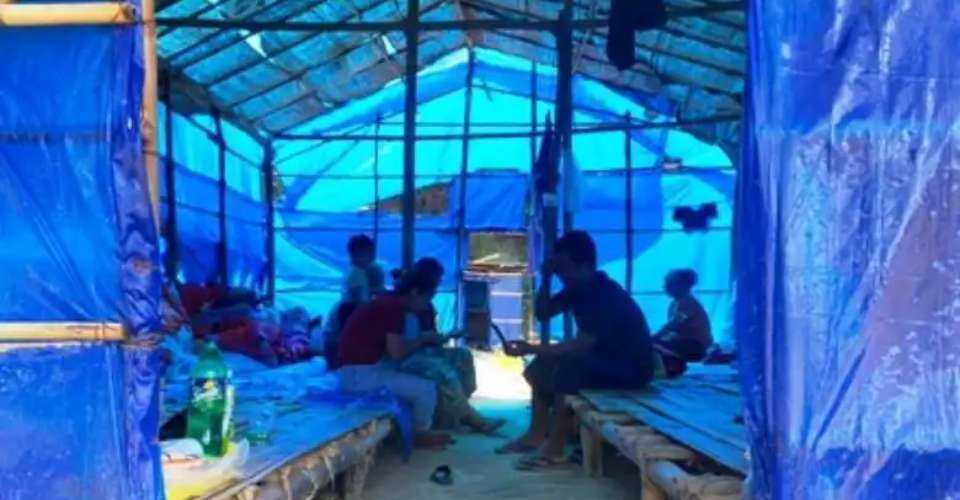
Refugees who fled Myanmar rest in a basic shelter at a camp in India's northeastern state of Mizoram near the Myanmar border on Sept. 23, 2021. The state's porous border has made it a key route for trafficking drugs, officials say. (Photo: AFP)
Churches across denominations, along with civil society groups in Christian-majority Mizoram, have decided to step up joint efforts to tackle the growing menace of drug abuse and trafficking, which is increasingly affecting the northeast Indian state’s youth and families.
The decision was made at a meeting on June 2 in the state capital, Aizawl, called by the Central Young Mizo Association (CYMA) and Mizoram Kohhran Hruaitute Committee (MKHC), an umbrella body representing the state’s major churches.
“The discussions focused on the urgent need for closer cooperation between religious institutions and community organizations to curb drug problems across Mizoram,” CYMA General Secretary Malsawmliana, who uses a single name, said.
The organization has designated the years 2025-2027 to combat drug abuse in the state.
“We approached all church denominations because they are already involved in awareness programs and counseling services. We want them to continue to fight this menace,” Malsawmliana told UCA News on June 4.
Bishop Stephen Rotluanga of Aizawl hailed the initiative, noting that young people in Mizoram are particularly vulnerable because narcotics are easily available in the region.
“Drug abuse is one of the most serious concerns facing both churches and civil society today,” the prelate told UCA News on June 4.
India shares an unfenced border stretching 1,643 kilometers with Myanmar, covering the four Indian states of Mizoram, Nagaland, Manipur and Arunachal Pradesh. It is also in proximity to the notorious Golden Triangle, one of Asia's largest narcotics-producing regions.
“Government agencies, civil society groups, and churches are already working to curb the problem,” Bishop Rotluanga said.
Many churches, regardless of denomination, operate social service centers that assist people struggling with drug addiction, alcoholism, and HIV/AIDS, he added.
The prelate hoped the latest initiative would strengthen the efforts to make Mizoram a drug-free state.
Government data recorded 118 drug-related deaths in 2025, the highest annual toll in more than two decades.
Heroin and methamphetamine remain the primary drugs fueling addiction and trafficking in the state, state authorities said.
On June 2, the state’s Excise and Narcotics Department seized 971 grams of heroin and arrested four suspected traffickers in a border area.
A day earlier, police intercepted a vehicle carrying 587 grams of heroin and arrested a 51-year-old woman allegedly transporting the drug from Churachandpur in neighboring Manipur state to Aizawl.
Officials say drug use is increasingly affecting youth, women and even minors across all eight districts of the state.
Districts bordering Myanmar, like Champhai, Siaha, Lawngtlai, Hnahthial, Saitual, and Serchhip, have become key routes for trafficking heroin, methamphetamine tablets, and other forms of contraband, officials noted.
Mizoram, sandwiched between Bangladesh and Myanmar, is one of India's only three Christian-majority states.
Some 87 per cent of the state’s 1.1 million people are Christian, according to the last national census held in 2011.
National Chung Cheng University of Crime Research Center - Education Center for Prevention of Drug Abuse
No.168, Sec. 1, University Rd., Minhsiung, Chiayi 621301, Taiwan 05 - 2724151 deptcrc@ccu.edu.tw